Perfect Numbers
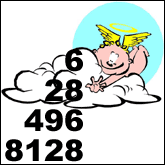
Some numbers are more special than others. The ancient Greeks called a few of them perfect. The first perfect number is 6; the second is 28. The Greeks knew of two more: 496 and 8,128. Can you see what they have in common? Try to work it out before you read on.
A perfect number is a positive whole number that equals the sum of its proper divisors: the numbers smaller than itself that divide into it without leaving a remainder.
- 6 = 1 + 2 + 3
- 28 = 1 + 2 + 4 + 7 + 14
- 496 = 1 + 2 + 4 + 8 + 16 + 31 + 62 + 124 + 248
Around 300 BC, Euclid found a recipe for making them: whenever 2p − 1 is a prime number, 2p−1 × (2p − 1) is perfect. For p = 2 that gives 2 × 3 = 6, and for p = 3 it gives 4 × 7 = 28. About 2,000 years later, Leonhard Euler proved that every even perfect number has exactly this form. Primes of the form 2p − 1 are called Mersenne primes, after Marin Mersenne, the French friar who studied them in the 1600s.
What about the fifth perfect number? Don't even try: it is 33,550,336, and it was first published by Hudalrichus Regius in 1536, more than 1,800 years after Euclid. Since every new perfect number requires a new Mersenne prime, and these are extremely rare, finding them is now a job for computers. All of the recent ones were found by GIMPS, the Great Internet Mersenne Prime Search, a project in which volunteers lend their computers to the hunt.
Today 52 perfect numbers are known. The largest, found in October 2024, is 2136,279,840 × (2136,279,841 − 1), a number with 82,048,640 digits. Every perfect number found so far is even, and every even perfect number ends in 6 or 8. Nobody knows whether an odd perfect number exists, or whether there are infinitely many perfect numbers at all. These are among the oldest unsolved problems in mathematics. Live and learn!