Category
Mathematics Facts
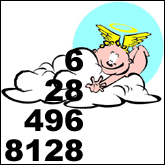
Perfect Numbers
Some numbers are more special than others. The ancient Greeks called a few of them perfect . The first perfect number is…
Unit Of Luminous Intensity (candela)
Originally, each country had its own, and rather poorly reproducible, unit of luminous intensity; it was necessary to…

Picture This
What 3 dimensional shape will pass through a rectangle, triangle and circle each time filling the whole space? The…
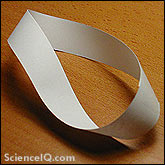
Mobius Strip
A Mobius Strip is an amusing three-dimensional object whose surface has only one side. Huh? Well, most objects you can…
All Mathematics facts
Algebra
Geometry
- Eratosthenes Measured Earth’s Circumference—Centuries Before Columbus Sailed
- How To Calculate The Area Of A Circle
- How To Calculate The Area Of A Cylinder
- How To Calculate The Area Of A Right Cone
- How To Calculate The Circumference Of A Circle
- How To Calculate The Volume Of A Cylinder
- How To Calculate The Volume Of A Right Cone
- Kepler's Conjecture
- Picture This
- What Is The Pythagorean Theorem?