New York to London in Less Than Two Hours
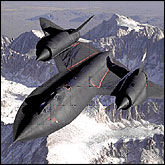
If flying from New York to London in less than two hours sounds like science fiction, read on. On September 1, 1974, U.S. Air Force pilot Major James V. Sullivan and reconnaissance systems officer Major Noel F. Widdifield flew an SR-71 Blackbird across the Atlantic in 1 hour, 54 minutes and 56.4 seconds, averaging about 1,807 miles per hour (2,908 km/h). The record still stands. The Concorde, the fastest airliner ever to carry passengers, needed almost an hour longer on its best crossing.
The SR-71 was a Cold War spy plane designed by Lockheed's famous "Skunk Works" and first flown in 1964. It cruised at more than Mach 3 and at altitudes above 80,000 feet (24 km), high enough for the crew to see the curvature of the Earth, and they wore pressure suits much like astronauts. In 1976 an SR-71 set the absolute speed record for a jet-powered aircraft, 2,193 mph (3,530 km/h), which also still stands.
Flying that fast creates enormous heat from air friction: parts of the plane's skin reached several hundred degrees Fahrenheit. That is why the airframe was built mostly of titanium, and why it was painted a special black paint that radiates heat away efficiently, earning it the nickname "Blackbird." Its shape and radar-absorbing materials also made it one of the first aircraft designed to be hard to see on radar, an early step toward today's stealth planes.
Only 32 SR-71s were built. The Air Force retired them in the 1990s, and NASA flew the last two for research until 1999; several are now on display in museums. The Blackbird remains the fastest air-breathing crewed aircraft ever flown. Only rocket planes have gone faster: the X-15 reached Mach 6.7 in 1967, and NASA's uncrewed X-43A, powered by an experimental scramjet engine, reached nearly Mach 10 in 2004.