Category
Mathematics Facts
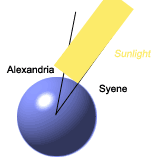
Eratosthenes Measured Earth’s Circumference—Centuries Before Columbus Sailed
Eratosthenes (c. 276 – 194 BC) was born more than 2200 years ago in the Greek city of Cyrene, now a city in the North…
Unit Of Luminous Intensity (candela)
Originally, each country had its own, and rather poorly reproducible, unit of luminous intensity; it was necessary to…

Leaps and Bounds
Leap years are years with 366 days, instead of the usual 365. Leap years are necessary because the actual length of a…
How To Calculate The Circumference Of A Circle
A circle is what you get if you take a straight line and bend it around so that its ends touch. You can demonstrate this…
All Mathematics facts
Algebra
Geometry
- Eratosthenes Measured Earth’s Circumference—Centuries Before Columbus Sailed
- How To Calculate The Area Of A Circle
- How To Calculate The Area Of A Cylinder
- How To Calculate The Area Of A Right Cone
- How To Calculate The Circumference Of A Circle
- How To Calculate The Volume Of A Cylinder
- How To Calculate The Volume Of A Right Cone
- Kepler's Conjecture
- Picture This
- What Is The Pythagorean Theorem?