How Do Bacteria Reproduce?
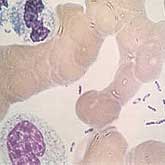
Bacteria are microorganisms that have been around for billions of years. How have they survived all that time? Microorganisms are experts at reproducing, not only can they produce new bacteria fast, but easily too. They have various methods of reproduction, including binary fission and budding. Both are simple, fast methods to produce more bacteria.
Binary fission is when a bacterium copies its DNA, to make an exact replica, and then partitions itself in two. The bacterium is actually making a clone of itself because the second has the same DNA as the first. This method of reproduction is so fast that a single microorganism could make a billion more just like itself, if conditions were right, in just 10 hours. Some bacteria reproduce by budding instead. A small bud grows out of the side of the 'mother' cell, receives a copy of its DNA, and eventually breaks off as a new cell. (Unlike plant and animal cells, bacteria have no nucleus; their DNA floats freely inside the cell.)
Binary fission and budding are also forms of asexual reproduction, which means the exact same DNA is passed on, sometimes called a clone. There is no need for another bacterium to swap DNA in asexual reproduction, but this makes it hard for bacteria to evolve. Therefore, they use conjugation to exchange DNA between two different bacteria. Conjugation is a little more complicated than binary fission or budding. It actually involves two bacteria. One bacterium extends a pilus, or long tubule used to exchange DNA, to the other bacterium. One bacterium passes some of its DNA, often a small ring of DNA called a plasmid, to the other; the pilus is then retracted and the bacteria go their separate ways, the recipient having picked up new traits, traits that will help them adapt better to different environments.