Solid Smoke
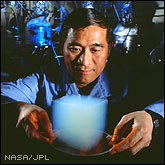
Have you ever wondered what the least dense solid in the world is? For years the answer was silica aerogel, nicknamed "solid smoke" or "frozen smoke" for its ghostly, translucent blue look. Aerogel was invented in the 1930s by the American chemist Samuel Kistler, who found a way to remove the liquid from a gel without collapsing its delicate solid framework. What is left is a sponge-like network of glass fibers far thinner than a hair, filled almost entirely with air.
Silica aerogel is made of silicon dioxide, the same compound as sand and glass, yet it is up to a thousand times less dense than glass and up to 99.8% air. In 2002, an aerogel made by Peter Tsou and colleagues at NASA's Jet Propulsion Laboratory entered the Guinness World Records as the lightest solid, at just 3 milligrams per cubic centimeter. That record has since been broken by carbon-based aerogels: in 2013, Chinese scientists made a graphene aerogel only about 0.16 mg per cubic centimeter, light enough to rest on the tip of a blade of grass.
Aerogel's tangled, air-filled structure makes it one of the best thermal insulators known: a thin layer can protect your hand from a blowtorch flame. NASA has used it to insulate Mars rovers, and today flexible aerogel blankets insulate pipelines, buildings, and even winter jackets and boots.
Aerogel can also catch things. In 1999, NASA launched the Stardust spacecraft carrying tennis-racket-shaped collectors filled with aerogel. In 2004 it flew through the tail of comet Wild 2, and the aerogel gently slowed and captured dust particles traveling six times faster than a rifle bullet, leaving behind carrot-shaped tracks. The samples returned to Earth in 2006, and scientists found glycine, one of the building blocks of proteins, in the comet dust. Not bad for solid smoke!