Why does popcorn pop?
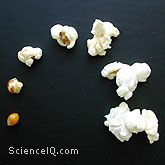
Popcorn is the most amazing food! It all starts with a kernel only a few millimeters across that explodes into a fluffy, tasty, white wonder 40 to 50 times bigger. Not just any corn will do: popcorn is a special variety of maize whose kernels have an unusually hard, airtight hull. Each kernel has three parts:
- the pericarp, the tough, shiny outer hull;
- the endosperm, mostly starch with a little protein, plus about 13 to 14 percent water; and
- the germ, the part that would sprout into a new plant. It plays no role in popping.
When you heat a kernel, the water inside heats up too. At 100 °C (212 °F) the water would normally boil away as steam, but the hull is so strong and airtight that the steam can't escape. Instead, the pressure builds inside the kernel, just like in a pressure cooker. Meanwhile, the hot steam cooks the starch into a soft, gooey gel.
At about 180 °C (356 °F), the pressure reaches roughly 9 atmospheres, about 135 pounds per square inch, and the hull suddenly bursts. The starchy gel puffs out, and as the steam escapes it expands and quickly sets into a crunchy, foam-like network of starch: the white part of popcorn. High-speed video shows that the bursting starch even forms a little "leg" that kicks against the pan, which is why popcorn jumps. The pop you hear is the steam suddenly escaping.
So why are there always a few unpopped kernels, or "old maids," at the bottom of the bowl? Usually their hull has a tiny crack that lets the steam leak out, or they have dried out and don't hold enough water to build up pressure. That's why popcorn should be stored in an airtight container. Mmm… I'm getting hungry. How about you? Let's pop a bag.